
Content intended for healthcare professionals. By continuing, you confirm you are a HCP.
Trabecular Bone Score
Trabecular Bone Score® (TBS®) enriches fracture-risk assessment by capturing the structural information BMD leaves out — the bone microarchitecture that helps determine whether bone breaks.
What is TBS?
Trabecular Bone Score® is an innovative analytic method that enriches fracture-risk assessment. Using a patented, modified experimental-variogram approach, the TBS® algorithm interprets subtle grey-level, pixel-by-pixel variations in a bone's projected DXA image and translates them into an estimate of three-dimensional bone microarchitecture.
TBS® correlates strongly with the intrinsic microarchitecture and mechanical competence of bone — complementing the BMD T-score, which primarily reflects bone quantity.
BMD and TBS
BMD measures how much bone is present. TBS® measures how well it's built. Two patients with an identical BMD can have very different microarchitecture — and very different fracture risk.
Why TBS?

Strong microarchitecture: High or average TBS®
Normal fracture risk

Fragile microarchitecture: Low TBS®
elevated fracture risk
TBS® adds the structural dimension that density alone can't see, so patients at risk of a fragility fracture hiding with a "normal" BMD are no longer missed.
The clinical need
of osteopenic patients are reclassified when TBS® is added to BMD — improving the accuracy of fracture-risk assessment, particularly in osteopenia and secondary osteoporosis.1
Explaining TBS to patients
A useful analogy for the clinic: Think of bone as a brick wall.
BMD describes the bricks: How much material is present. TBS® describes the quality: The condition of the bricks, how those bricks are placed, and the mortar between them.

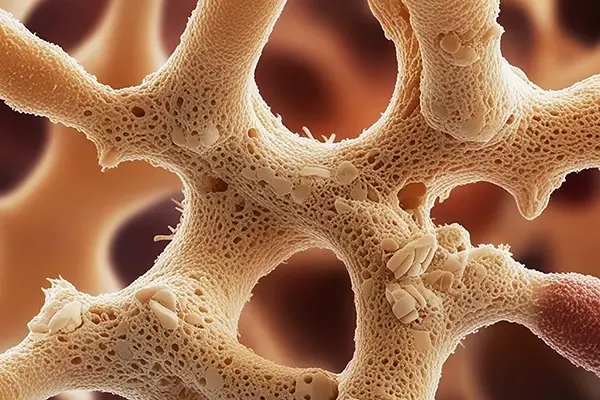
Osteopenic bone density
TBS® reveals the fracture risk BMD alone can miss
TBS · Trabecular Bone Score
TBS® is a patented, validated analytical index derived from routine DXA scans, revealing the internal structural quality of bone that BMD cannot measure. More than a decade of peer-reviewed research underpins its clinical use worldwide.
4.5M+
TBS® evaluations performed annually2
1,600+
peer-reviewed publications2
30+
clinical guidelines citing TBS®2
90+
countries with clinical deployments2
Clinically proven
2026 · Diagnostics
Razvan, D.V., Rosca, O., et al.
2024 · The Journal of Clinical Endocrinology and Metabolism
Bioletto, F., Barale, M., et al.
2023 · Osteoporosis International
Hans, D., McDermott, M., et al.
Go deeper
Everything behind TBS®: The analytic method, the biology, the clinical applications, and the published record.
Bone microarchitecture
The internal structure of bone, and why it determines strength, independent of density
TBS in secondary osteoporosis
How disease and treatment degrade bone quality, including cancer, diabetes, HIV, endocrine, and more
Publications
A selection of peer-reviewed literature, filterable by topic, and indication
We help clinicians reveal more from routine imaging — every patient, every scan — for better care.